Funnel Entry Optimization: Zip Code vs. Address
Conversion Rate Experimentation

Overview
Sunday's funnel required personal data (climate zone, grass type, lawn size, yard conditions) to build a custom plan. The most direct way to get it was to ask for a home address upfront. It worked technically, but it was costing us customers before they even got started.
Moderated user testing surfaced a consistent pattern: asking for an address at the top of the funnel felt invasive. People dropped off before we could show them what Sunday could do. This case study documents three iterative A/B tests I designed over six weeks that reframed address entry from a requirement into a convenience. This unlocked a 21% lift in funnel entry, an 11.4% lift in account creation, and a 5.9% lift in plan purchases.
The Problem
With an address, we could map a customer's lawn automatically and build a truly custom plan. Great experience, if you got there. The research showed customers were reluctant to hand over personal information before they understood what they were getting in return. It felt like surveillance, not service. We needed to earn the right to ask for it.
The real problem wasn't the custom plan. It was getting customers to enter the funnel at all.
The Hypothesis
Ask for a zip code first. Reposition address entry as an optional convenience for customers who didn't know their lawn size. The zip code gave us enough to get started (climate zone, grass type region, general location) and once customers were engaged, they'd be more willing to share more.


Test 1: Proof of Concept
May 16 · Homepage only · ~34k visitors
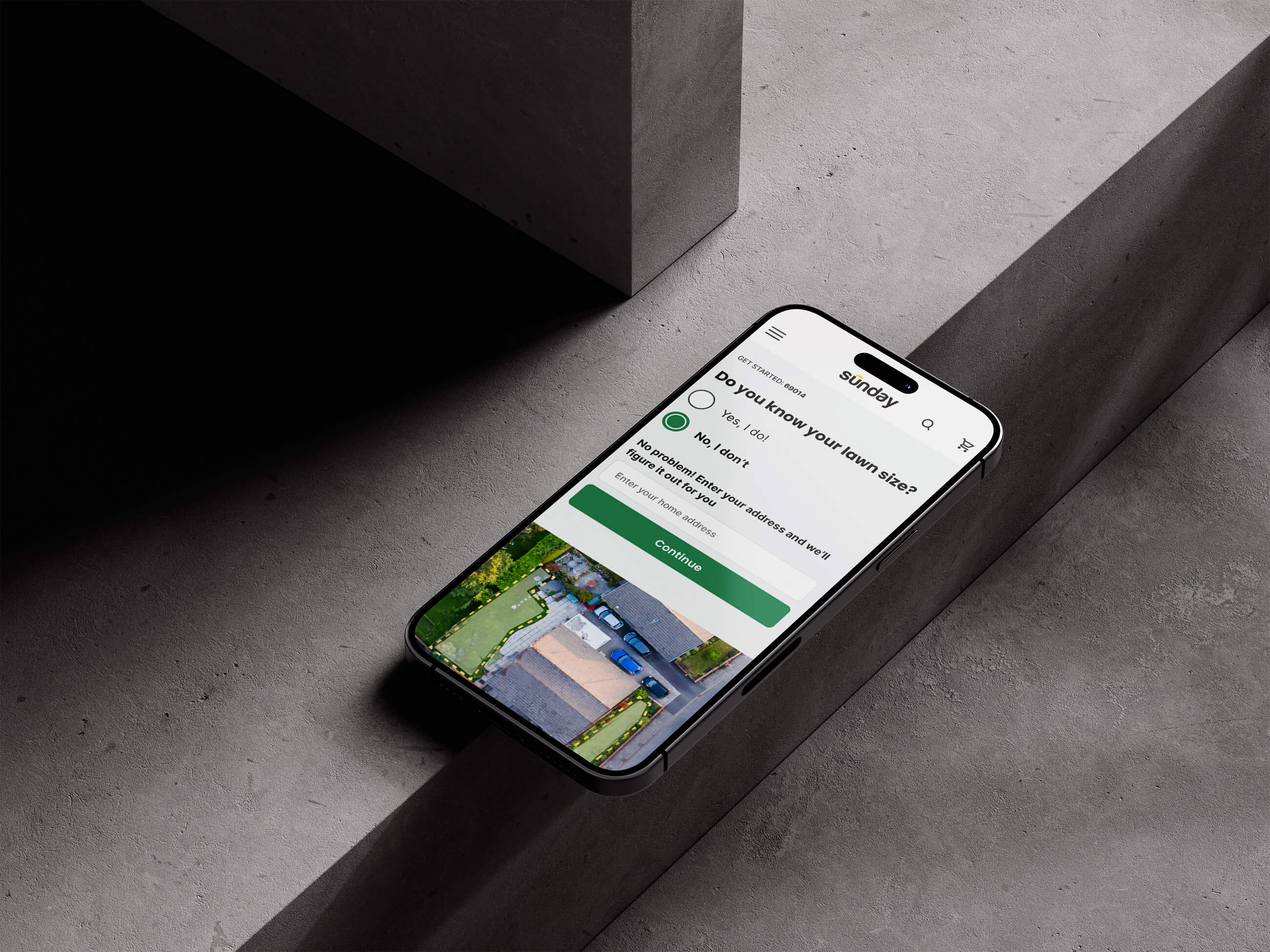
The homepage had asked for an address as step one for years. We ran a test with zip code entry as the B option, then asked: Do you know your lawn size? — branching to either a square footage input or optional address entry to calculate it for them.
Funnel entry jumped +15.2% (high statistical confidence). Account creation up +2.34%. But the test had noise — it only ran on the homepage, and customers could still hit the address-first flow on other pages. We also set "Address Entered" as our primary metric, which made the variant look like a loser. It wasn't — fewer people entering their address was the point. We needed better measurement.
Test 2: Expanding the Surface, Cleaning the Signal
May 23 · Homepage + CLP page + paid traffic · ~232k visitors
We expanded to the CLP page where most paid traffic landed, reducing session-level noise and growing the sample to ~232k visitors. The signal got stronger:
Funnel entry: +19.14%
Account creation: +8.56%
Plan purchase: -4.35% (statistically inconclusive)
Top-of-funnel was clearly working. But the purchase gap remained — suggesting friction further in the flow, specifically the lawn size step.
Test 3: Removing the Last Friction Point
June 26 · All entry points · Winning variant
The design had evolved from a single page with stacked inputs to a two-step flow with a yes/no branch. The remaining problem: customers who said yes to knowing their lawn size still faced a blank sq footage field — a precise number most homeowners don't know.
I knew from our backend that plan quantities are determined by square footage ranges, not precise numbers. Precision wasn't required. So I replaced the free-text input with a dropdown of our most common size ranges, with the system using the midpoint automatically. The "Other" option remained for anyone who wanted to enter an exact number, and address entry stayed available as a fallback.
Zip code entry also expanded to all three entry points, eliminating any remaining path to the old address-first experience.


Results
Every metric moved in the right direction for the first time:
+21% funnel entry — more customers starting the personalization journey
+11.4% account creation — more leads captured
+5.9% plan purchase — conversion lift that closed the loop on the business goal
Consistent experience across all funnel entry points (no measurement noise)
The test was called July 2 and pushed to 100% of traffic as the new baseline.
Reflections
Define the right metric before you ship. We launched test 1 measuring "Address Entered" — which made the variant look like a loser. Starting with account creation as the primary metric from day one would have let us iterate faster.
Connect design to the data model. The dropdown ranges weren't just a UX simplification — they were rooted in how our backend actually worked. Plan quantities are calculated from ranges, not precise measurements. Understanding that made the design decision obvious.
Iteration compounds. Test 1 validated the hypothesis. Test 2 confirmed it at scale. Test 3 closed the gap. Each one was better because of what came before it.