Yard Funnel: One Plan, Three Categories
From lawn-only to a full yard subscription — without breaking the business.

Overview
Sunday was a lawn company selling yearly lawn care subscriptions. The strategic bet was to become a yard company: combining lawn, pest, and garden subscriptions into one cohesive experience, a move the team believed could triple its market over 3 to 5 years.
Partnering with a Product Manager and three engineers, we built the first Yard Funnel: a unified experience for creating a personalized yearly plan across all three categories. As the product designer, I led the end-to-end design process, using ~12 prototypes and multiple rounds of user testing to shape the final experience.
The Challenge
Three categories in three different states. Lawn was mature and revenue-generating. Pest lived in a separate, older funnel built around different plan logic and a different PSP (plan selection page). Garden didn't have a customer experience at all. We had to design a new funnel and PSP system that could host all three categories cohesively, build the garden experience from scratch, and reconcile pest's structure with the new model.
The hard constraint: Lawn CVR couldn't drop. Lawn was paying for the experiment, so any new yard experience had to be at least as good as the old lawn-only one.
Process
The foundational question was structural, not visual: how should three categories coexist in one funnel — grouped on one PSP, visually separated, or split across separate PSPs? Each option shaped cognitive load, perceived price, and how customers encountered tradeoffs.
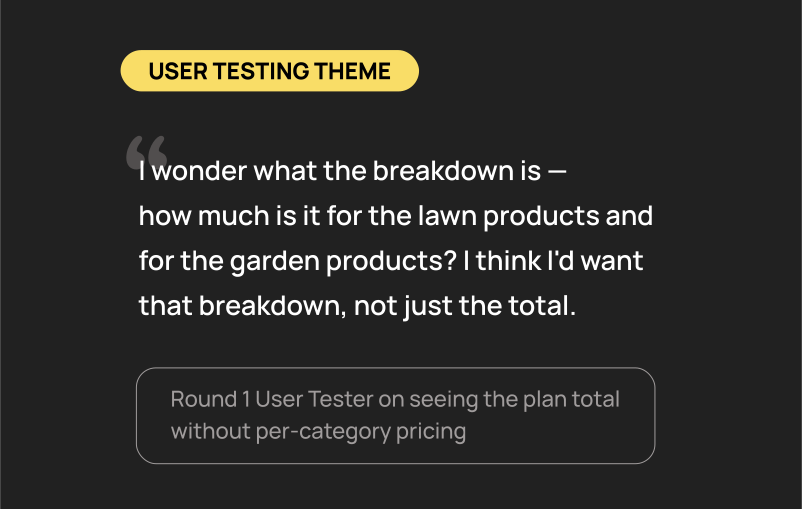
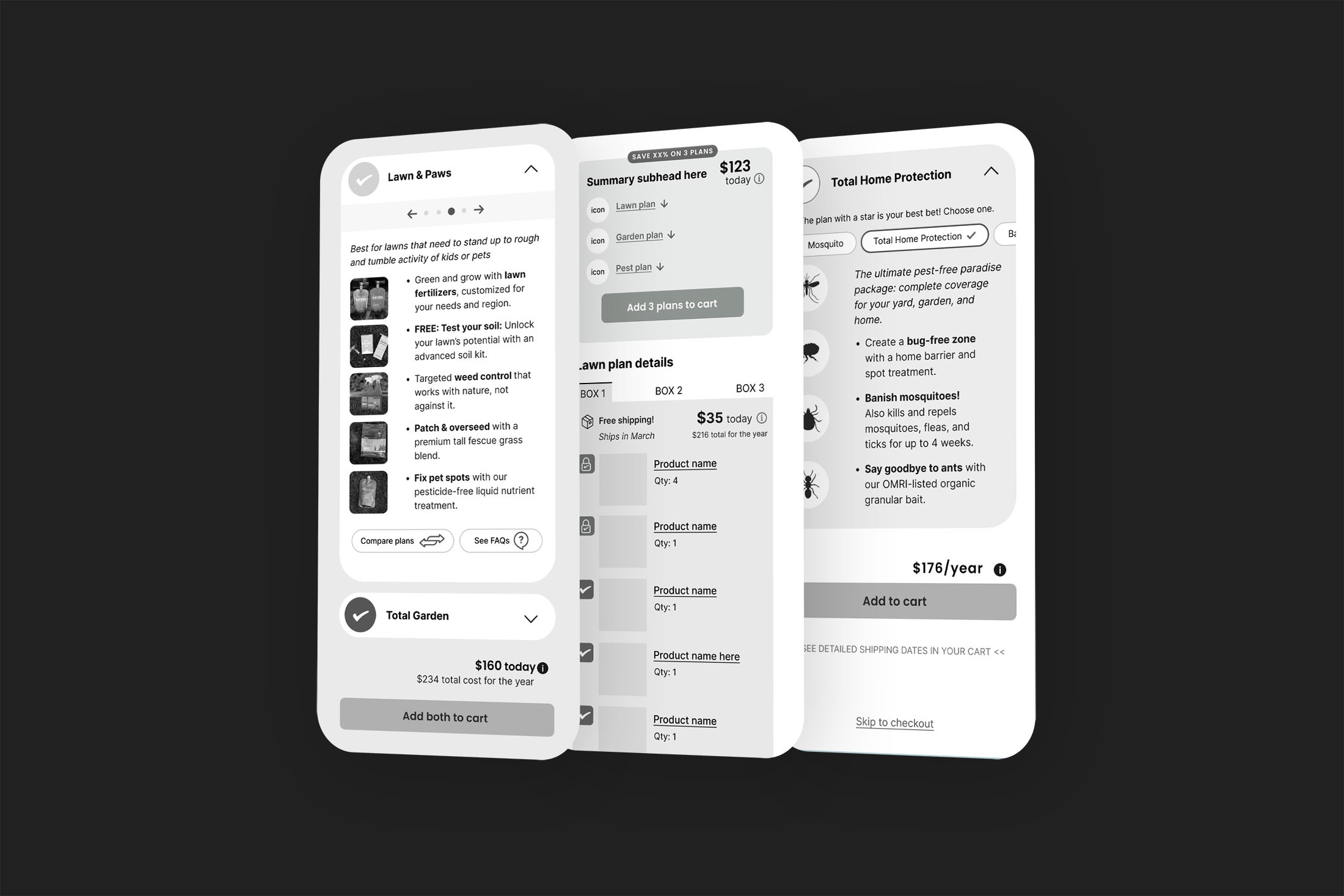
We tested ~12 prototypes across ~50+ user sessions, varying layout, progress bars, interstitials, and timelines. Grouped layouts won clearly: with all three categories on one page, customers scored highest on plan confidence, removing items, and payment understanding. Separate PSPs forced context-switching and broke the at-a-glance feel of one cohesive plan.
The harder sub-problem was when to ask the questionnaire. Two attempts failed. Stacking all three Q&As upfront drove drop-off before customers saw a price. The other: splitting lawn and pest across separate PSPs — quiz, then PSP and add to cart, then quiz again, then a second PSP and add to cart. It felt like two disconnected purchases.
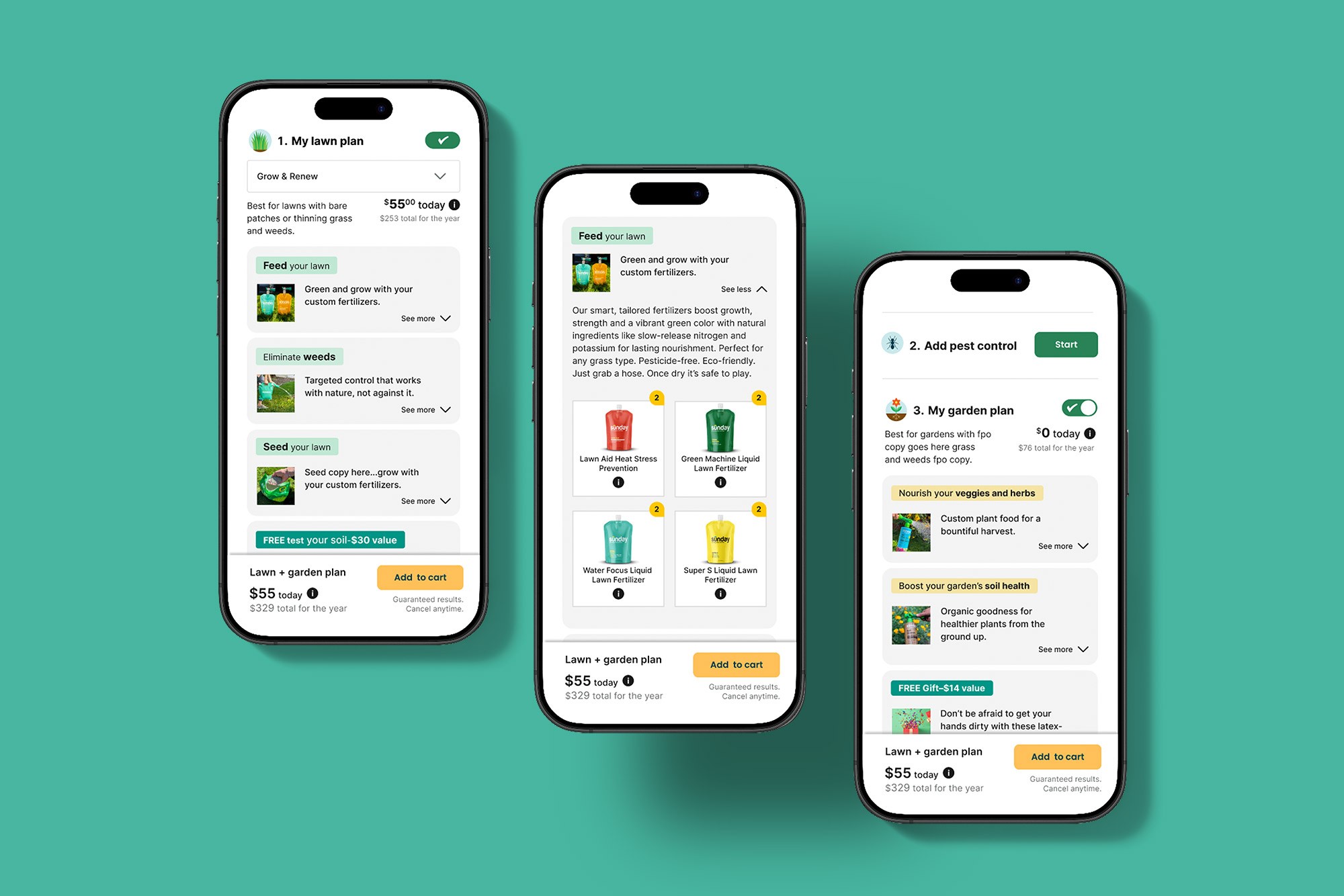
The PSP was also reframed around named solutions — "Feed your lawn," "Eliminate weeds," "Seed your lawn" — that grouped products by customer goal, with freebies as distinct callouts. The componentized structure kept plan value legible at a glance and the system flexible across iteration.

Results
The MVP shipped in two variants — one keeping pest's original plan configurations inside the new funnel, one with a more customized "Pest-In-Lawn" configuration. We launched in January, before peak season, and ran into two problems fast: traffic was too thin to get a clean read on the test, and the early directional signal showed lawn CVR dipping. With spring lawn sub numbers as a hard business target, the PM and execs decided we couldn't risk lawn sales during peak season. The test was paused and iteration waited until after the main spring push.
When we came back to it post-season, we tested a new Multi-Category PSP that unified all three categories on a single plan selection page. The bundled experience clearly worked on attach and engagement:
Garden plan attach: ~3x
Pest plan attach: ~2x
Pest and Garden Q&A completion: ~3x more likely to finish
PSP bounce rate: 46% → 33%
iAOV: +$10
The cost: Lawn CVR dropped ~7%. With Lawn CVR as our guardrail, we paused the test to iterate rather than push for the additional ~24 days VWO estimated for stat-sig confidence. The decision wasn't "this didn't work" — it was "the math doesn't yet justify continuing live while we have a clear iteration list."
Navigating the Guardrail
The honest tension of this project: a yard funnel is a longer funnel. More questions, more decisions, more perceived price before a customer sees their lawn plan. We knew going in that asking customers to complete three Q&As before seeing their lawn could pull CVR down — and it did, in line with prior stacked-PSP tests that had shown roughly the same effect.
The iteration roadmap that came out of the test was specific: bring back product thumbnails inside the solution cards, make plan copy dynamic to the customer's quiz answers, and add a mobile sticky footer so customers could see price update in real time as they toggled pest and garden on. The pause wasn't an ending — it was a checkpoint with a clear next move.

Iterating into Wins
The team didn't stop after the pause. We kept testing and I kept designing into what user research and the data were showing us. The iterations on the multi-category PSP started compounding into wins:
Product thumbnails inside solution cards: +2.3% on any plan purchase, +$12 iAOV, 2x pest plan CVR
"Best" plan recommendations for customers who said they didn't know what they wanted: +$14 iAOV
Mobile sticky footer so customers could see price update in real time as they toggled categories on
Subsequent PSP work — surfacing first read-more interactions, integrating mobile-app preview and personalized guidance — kept driving measurable lift on plan purchases through 2026
As the iterations landed, lawn CVR, our original guardrail, stabilized and then climbed 2% above baseline, alongside the attach and iAOV gains across pest and garden.
Reflections
The Yard Funnel didn't land as a single launch-and-celebrate moment. It landed as a system that could absorb learnings, ship iterations, and compound wins across all three categories. The discipline that made that possible was treating the structural question as the design question upfront, and staying honest about the CVR tradeoff instead of just pointing to the easy wins.